1. Introduction
There are some classic recipes that truly stand the test of time, and the Caesar salad is undoubtedly one of them. Its creamy, tangy dressing and crisp texture are universally loved. But what if I told you we could take this beloved dish, give it a healthier, more vibrant twist, and make it even more irresistible? My recipe for Kale Caesar Salad does just that, transforming a simple side into something truly special. Get ready to enjoy a delicious, easy-to-make salad elevated by a unique nutty crunch that boosts both flavor and nutrition.
2. Why You’ll Love This Kale Caesar Salad Recipe
This Kale Caesar Salad stands out from any other you have tried. Here is why it will quickly become a favorite in your kitchen.
Nutty Flavor and Crunch: I have added toasted sunflower seeds to the crispy garlic breadcrumb topping. This isn’t just for texture; it brings a delightful nutty depth that perfectly complements the savory Caesar dressing.
Enhanced Nutrition: Beyond the delicious flavor, those toasted sunflower seeds are a powerhouse of Vitamin E and healthy fats, turning this salad into a truly antioxidant-rich meal. The kale itself is packed with vitamins and minerals, making this a healthier choice than many traditional salads.
Healthier Twist: By utilizing nutrient-dense kale and thoughtfully enhancing the dressing, this version offers all the satisfaction of a classic Caesar salad with added health benefits. It is a fantastic way to enjoy a guilt-free pleasure.
Easy to Make at Home: Despite its gourmet appeal, this recipe is incredibly straightforward. You can whip up this Kale Caesar Salad in minutes, making it perfect for weeknight dinners or quick lunches.
Versatile Dish: Whether you serve it as a refreshing side dish or a satisfying light meal topped with extra protein, this kale salad is incredibly versatile. It is sure to be a crowd-pleaser for any occasion.
3. Ingredients Needed

To create this exceptional Kale Caesar Salad, gather these fresh ingredients:
2 bunches (12-14 ounces) Tuscan (lacinato) kale
extra virgin olive oil (for drizzling)
crispy garlic panko breadcrumbs
parmigiano-reggiano cheese (as desired )
hard-boiled eggs (optional (see notes))
2-3 anchovy fillets packed in olive oil (drained)
2 medium garlic cloves
kosher salt
3 large egg yolks (local or pasture-raised)
2 teaspoons Dijon mustard
¼ teaspoon Worcestershire sauce
⅓ cup (80 mL) avocado or vegetable oil
1 tablespoon (15 ml) freshly squeezed lemon juice
⅓ to ½ cup finely grated parmigiano-reggiano cheese (plus more for topping )
½ teaspoon freshly ground black pepper (plus more to taste )
Ingredient Notes & Substitutions
Best Type of Kale: For this Kale Caesar Salad, I always recommend using Tuscan kale, also known as lacinato kale or dinosaur kale. Its leaves are more tender and have a milder, sweeter flavor compared to curly kale, making it perfect for salads.
Anchovy Substitutes: While anchovy fillets are essential for that classic umami depth in Caesar dressing, you can achieve a similar savoriness with alternatives. Try capers, a teaspoon of miso paste, or simply increase the Worcestershire sauce for a vegetarian option.
Gluten-Free Breadcrumb Options: If you are looking for gluten-free alternatives to panko breadcrumbs, consider crispy roasted chickpeas, a sprinkle of almond flour, or even gluten-free panko breadcrumbs for that desired crunch.
Dairy-Free Options: To make this Caesar salad dairy-free, replace the parmigiano-reggiano cheese with nutritional yeast for a cheesy flavor, or use a cashew-based dressing for creaminess.
Oil Options: I prefer using avocado oil in my Caesar dressing for its neutral flavor and healthy monounsaturated fats. However, a good quality vegetable oil will also work well for the emulsification. While extra virgin olive oil is great for drizzling, its strong flavor can sometimes overpower a delicate Caesar dressing.
Egg Yolks: Since the egg yolks in this Caesar dressing are raw, it is crucial to use the freshest, highest-quality eggs you can find. Local or pasture-raised eggs are ideal for both flavor and safety.
4. How to Make Kale Caesar Salad
Creating this Kale Caesar Salad is a delightful process, broken down into simple, manageable steps.
Step 1: Prepare the Kale Leaves
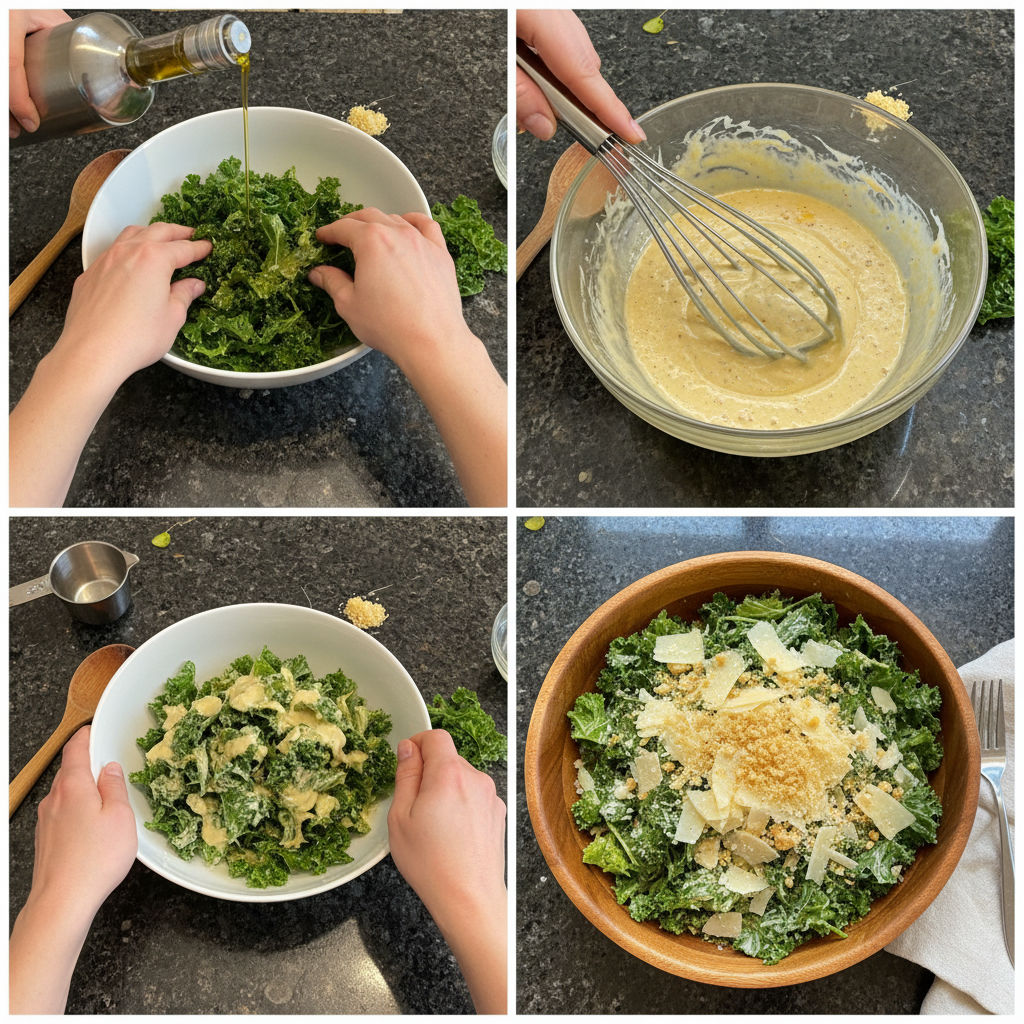
First, take your bunches of Tuscan kale. Strip the leaves from the tough, fibrous stems, discarding the stems. Thoroughly wash and dry the kale leaves. I use a salad spinner to ensure they are perfectly dry, which helps the dressing cling better.
To prepare the kale for serving, stack several kale leaves on top of each other and roll them lengthwise into a tight log. Slice crosswise into thin ribbons, aiming for roughly ½-inch thick pieces, and place them in a large salad bowl. Repeat this process with the remaining kale leaves.
Now for the magic touch: Drizzle the kale with a small amount of extra virgin olive oil. Using both hands, gently massage the kale leaves. You will feel them soften and wilt slightly, and the kale should turn a vibrant green color, indicating it is ready. This step is crucial for making the kale tender and more digestible. Don’t over-massage the kale, or it will become mushy. Set the massaged kale aside while you prepare the Caesar dressing.
Step 2: Make the Caesar Dressing
On a clean cutting board, place the drained anchovy fillets and garlic cloves. Sprinkle them lightly with kosher salt. Using the side of your knife, finely chop and mash these ingredients together until they form a smooth paste. The anchovy-garlic paste should smell pungent and garlicky. This paste is the heart of your Caesar dressing.
In a medium mixing bowl, place the three large egg yolks. Add the anchovy-garlic paste, Dijon mustard, and Worcestershire sauce to the bowl. Whisk these ingredients together until well combined.
Now, for the emulsification: Slowly pour in the avocado or vegetable oil. Start with small droplets, whisking continuously with your other hand. Gradually increase to a very fine stream as the dressing begins to thicken. Continue whisking until the dressing is thick, creamy, and beautifully emulsified. The slow addition of oil is key to preventing the dressing from breaking.
Finally, stir in the freshly squeezed lemon juice, finely grated parmigiano-reggiano cheese, and freshly ground black pepper. Taste the dressing and season it to your preference, adding more salt and freshly ground black pepper as needed.
Step 3: Assemble the Salad
Return to your prepared kale. Gently toss the massaged kale with just enough Caesar dressing to evenly coat the leaves. Be mindful not to overdress; you will likely have some dressing leftover, which can be stored for later.
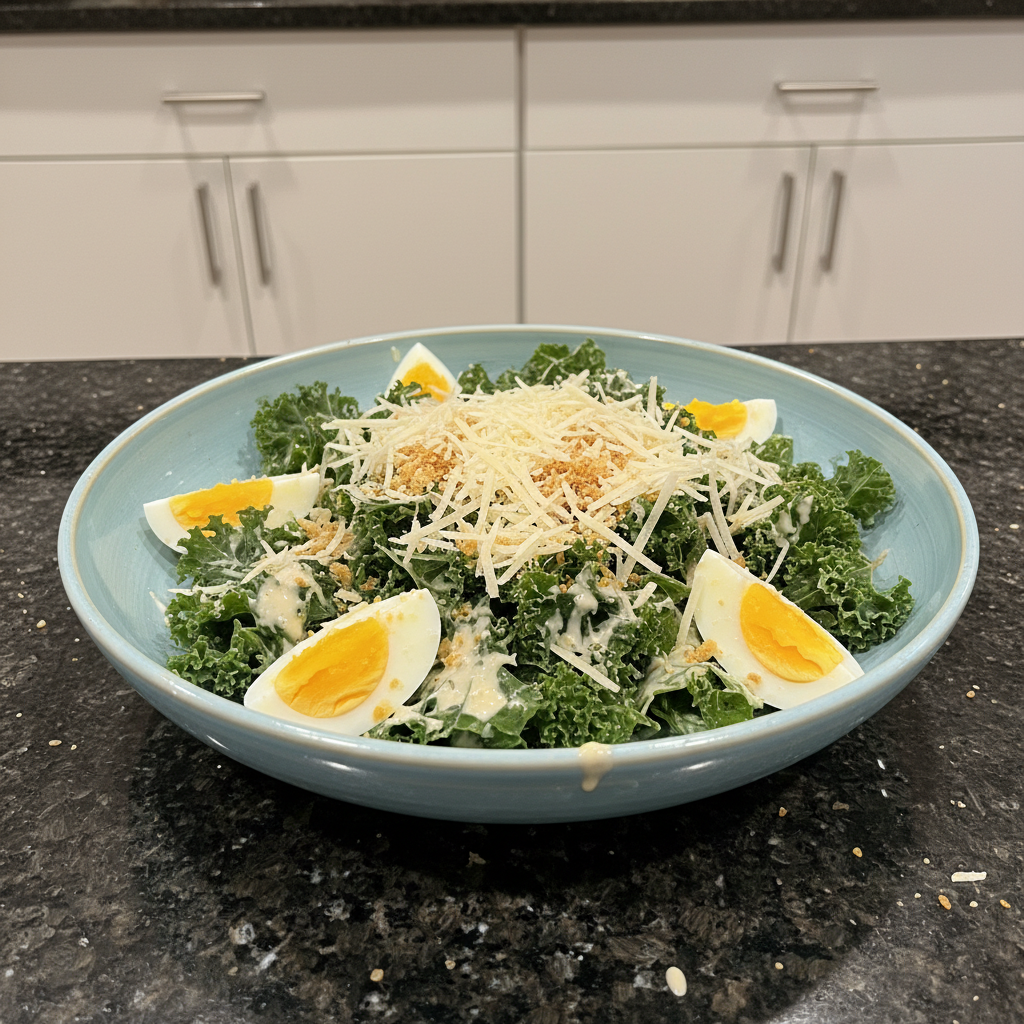
Season the salad to taste, adding more salt and freshly ground black pepper if desired. To finish, top each serving generously with crispy garlic bread crumbs and a dusting of parmigiano-reggiano cheese, finely grated with a microplane for a delicate texture. For a more substantial main course, you can serve this delicious Kale Caesar Salad alongside sliced hard-boiled eggs, grilled chicken, or fish.
5. Understanding Caesar Dressing Emulsification
The rich, creamy texture of classic Caesar dressing is all thanks to a scientific process called emulsification. Simply put, an emulsion is a stable mixture of two liquids that normally do not mix, like oil and water (or in our case, oil and lemon juice).
In our Caesar dressing, the oil and lemon juice are brought together through the action of emulsifiers. The raw egg yolks are the primary emulsifier. The lecithin in the egg yolks has both water-loving and fat-loving parts, allowing it to act as a bridge between the oil and the water-based ingredients (like lemon juice and Worcestershire sauce). Dijon mustard also plays a supporting role as an emulsifier, helping to stabilize the mixture.
When you slowly drizzle the oil into the egg yolk mixture while whisking continuously, you are breaking the oil into tiny droplets. These droplets become coated by the emulsifiers from the egg yolks and mustard, preventing them from coalescing back into larger oil layers. This creates a stable, thick, and creamy dressing.
If your dressing breaks or separates, it usually means the oil was added too quickly, or the mixture became too cold. To fix a broken dressing, start with a fresh egg yolk in a clean bowl. Slowly whisk in the broken dressing, a teaspoon at a time, until it re-emulsifies.
Different oils can affect both the emulsion and the flavor. Avocado oil is my preferred choice for its neutral flavor and smooth emulsification. Extra virgin olive oil can be used, but its stronger flavor can sometimes dominate the dressing, and it can be a bit trickier to emulsify if it’s very robust. Vegetable oil works as a neutral alternative but offers fewer health benefits than avocado oil.
6. Pro Tips & Troubleshooting
Pro Tips
Massage the kale thoroughly for the best texture and digestibility. This breaks down the tough fibers and makes the kale more palatable for salads.
Make the dressing right before serving for the freshest flavor. The bright notes of lemon and garlic are best enjoyed soon after preparation.
Toast the sunflower seeds until golden brown for maximum flavor. This simple step unlocks their full nutty potential.
Use a microplane to finely grate the Parmesan cheese for a delicate texture. This ensures the cheese melts into the dressing and toppings beautifully.
Don’t overdress the salad; start with a little and add more as needed. You want the kale to be coated, not swimming in dressing.
Prepare the breadcrumbs in advance to save time. Crispy breadcrumbs can be made ahead and stored, making salad assembly quicker.
Common Mistakes to Avoid
Using old or pre-shredded Parmesan cheese lacks flavor. Always opt for fresh parmigiano-reggiano cheese and grate it yourself.
Over-massaging the kale will make it mushy. Massage until it is just softened and vibrant green, then stop.
Adding too much dressing makes the salad soggy. Start with a conservative amount and add more if needed.
Skipping the anchovies removes the essential umami flavor for the classic Caesar. They are truly vital to the depth of the dressing.
Using low-quality eggs can affect the taste and safety of the dressing. Always choose fresh, high-quality, local, or pasture-raised eggs.
Not toasting the sunflower seeds means a missed flavor opportunity. Toasting them brings out their full nutty aroma and enhances the overall taste.
7. Serving & Storage
Serving Ideas
This Kale Caesar Salad is incredibly versatile. Serve it as a refreshing side dish alongside grilled chicken, flaky fish, or even a hearty steak for a balanced meal.
For added protein, top your salad with perfectly sliced hard-boiled eggs, making it a complete and satisfying lunch.
Elevate the crunch factor by adding salt and vinegar roasted chickpeas as another topping.
If you are looking for a lighter option, you can also pair this salad with a simple vinaigrette on the side as an alternative dressing.
Storage and Make-Ahead
You can store leftover Caesar dressing in an airtight container in the refrigerator for up to 2 days. Due to the raw eggs, I recommend consuming it quickly.
Store the massaged kale separately from the dressing to prevent it from becoming soggy. Kale dressed too far in advance can lose its texture.
Do not freeze the salad as the kale will wilt and become mushy upon thawing, completely ruining the texture.
Breadcrumbs, including those with toasted sunflower seeds, should be stored in an airtight container at room temperature to maintain their crispness. They can last for several days this way.
8. Conclusion
This Kale Caesar Salad recipe is truly a revelation, taking a beloved classic and elevating it with the healthful, nutty crunch of toasted sunflower seeds. It is a testament to how simple twists can transform a dish, offering a healthier, more flavorful, and incredibly satisfying experience. Easy to prepare and bursting with vibrant flavors, this salad proves that eating well can be both delicious and effortless. I encourage you to try this recipe today and make it your own. Experiment with the serving ideas and customize it to your heart’s content. Share your creations with us!
9. FAQ
What type of kale is best for Caesar salad and why?
Tuscan kale, also known as lacinato kale or dinosaur kale, is best for Caesar salad. Its leaves are more tender, have a milder flavor, and a softer texture when massaged, making it ideal for raw consumption in salads compared to the tougher curly kale.
What is the best way to massage kale for salads?
After stripping the leaves from the stems and washing them, drizzle the kale with a little extra virgin olive oil. Use both hands to gently rub and squeeze the kale leaves for 2-3 minutes until they become tender, slightly wilted, and turn a vibrant green color. This breaks down the fibers and makes the kale more palatable.
How long can homemade Caesar dressing be stored safely?
Due to the raw egg yolks, homemade Caesar dressing should be stored in an airtight container in the refrigerator and consumed within 2 days for optimal freshness and safety.
Can I make Caesar dressing without anchovies, and what is the best substitute?
Yes, you can make Caesar dressing without anchovies. For a similar umami depth, you can use a teaspoon of miso paste, capers, or simply increase the amount of Worcestershire sauce in the recipe.
What are some gluten-free alternatives to breadcrumbs in this salad?
Excellent gluten-free alternatives include crispy roasted chickpeas, a sprinkle of almond flour, or specifically certified gluten-free panko breadcrumbs. Toasted nuts or seeds (like the sunflower seeds in this recipe) also add a great crunch.
How can I make this salad a complete and balanced meal?
To make this Kale Caesar Salad a complete meal, add a source of protein such as grilled chicken breast, salmon, shrimp, or sliced hard-boiled eggs. You could also include roasted chickpeas or white beans for extra protein and fiber.
Can I use a food processor to make the Caesar dressing?
Yes, you absolutely can use a food processor or a blender to make the Caesar dressing. Add all ingredients except the oil to the processor and blend until smooth. Then, with the processor running, slowly drizzle in the oil through the feed tube until the dressing is thick and emulsified. This method often makes it easier to achieve a smooth emulsion.
Is it safe to use raw egg yolks in Caesar dressing?
Using raw egg yolks carries a small risk of salmonella. To minimize this risk, always use the freshest, highest-quality eggs available, preferably local or pasture-raised. Some people also opt for pasteurized eggs, which are heat-treated to eliminate bacteria.
Best Kale Caesar Salad Recipe with Crispy Sunflower Seeds
Ingredients
Equipment
Method
- First, strip the leaves from the tough, fibrous stems of your Tuscan kale, discarding the stems. Thoroughly wash and dry the kale leaves, ideally using a salad spinner.
- To prepare the kale for serving, stack several kale leaves on top of each other and roll them lengthwise into a tight log. Slice crosswise into thin ribbons, aiming for roughly ½-inch thick pieces, and place them in a large salad bowl. Repeat with the remaining kale leaves.
- Drizzle the kale with a small amount of extra virgin olive oil. Using both hands, gently massage the kale leaves until they soften, wilt slightly, and turn a vibrant green color. Set the massaged kale aside.
- On a clean cutting board, place the drained anchovy fillets and garlic cloves. Sprinkle lightly with kosher salt. Using the side of your knife, finely chop and mash these ingredients together until they form a smooth, pungent paste.
- In a medium mixing bowl, combine the three large egg yolks, the anchovy-garlic paste, Dijon mustard, and Worcestershire sauce. Whisk these ingredients together until well combined.
- For emulsification, slowly pour in the avocado or vegetable oil. Start with small droplets while whisking continuously, then gradually increase to a very fine stream as the dressing begins to thicken. Continue whisking until the dressing is thick, creamy, and beautifully emulsified.
- Finally, stir in the freshly squeezed lemon juice, finely grated parmigiano-reggiano cheese, and freshly ground black pepper. Taste the dressing and season it to your preference, adding more salt and pepper as needed.
- Return to your prepared kale. Gently toss the massaged kale with just enough Caesar dressing to evenly coat the leaves. Be mindful not to overdress; you will likely have some dressing leftover.
- Season the salad to taste, adding more salt and freshly ground black pepper if desired. To finish, top each serving generously with crispy garlic bread crumbs, toasted sunflower seeds, and a dusting of finely grated parmigiano-reggiano cheese.
- For a more substantial main course, serve alongside sliced hard-boiled eggs, grilled chicken, or fish.
Notes

Emily Thompson is a home cook and food enthusiast who believes that great meals bring families together. She loves exploring creative twists on classic American comfort food, always testing new ideas in her kitchen. Emily is passionate about sharing simple, practical recipes and time-saving tips to help busy people enjoy cooking at home. Her approachable style makes every dish accessible, delicious, and perfect for those seeking inspiration for everyday meals and special occasions. Find Emily’s latest creations and kitchen wisdom on yumeasymeals.com.